
Have you ever dragged your heavy carry-on through a sprawling airport, regretting every non-essential item you packed? Or felt a twinge of panic wondering if your beloved, carefully packed spinner will actually fit into the overhead bin? These universal travel pains point to a fundamental gap between how we move and the containers we move within. The emergence of innovative personal transport like the Airwheel electric smart luggage isn’t just a cool gadget trend; it’s a user-driven push that could, eventually, encourage a rethink of those rigid overhead bin dimensions. Let’s explore how.
Airwheel isn’t merely adding wheels to a battery. It reimagines the luggage as a personal mobility device. Take the popular Airwheel SE3S model as an example. At its core, it’s a sturdy 20L cabin-sized suitcase. But with its integrated system, it transforms. Its key functions are game-changers: Firstly, it’s **Rideable**. With a max speed of 13km/h, it lets you glide across terminal halls, turning a long trek to your gate into a quick, effortless ride. Secondly, it offers **App-Enhanced Control**. While you can simply step on and go (no app required for basic riding), connecting via the app allows for forward/backward remote control via your phone, with steering handled by the luggage’s handlebar – perfect for navigating while holding a coffee. Finally, it features **Find My Integration**. Leveraging Apple’s Find My network, you can locate your luggage if it goes missing, adding a layer of security.
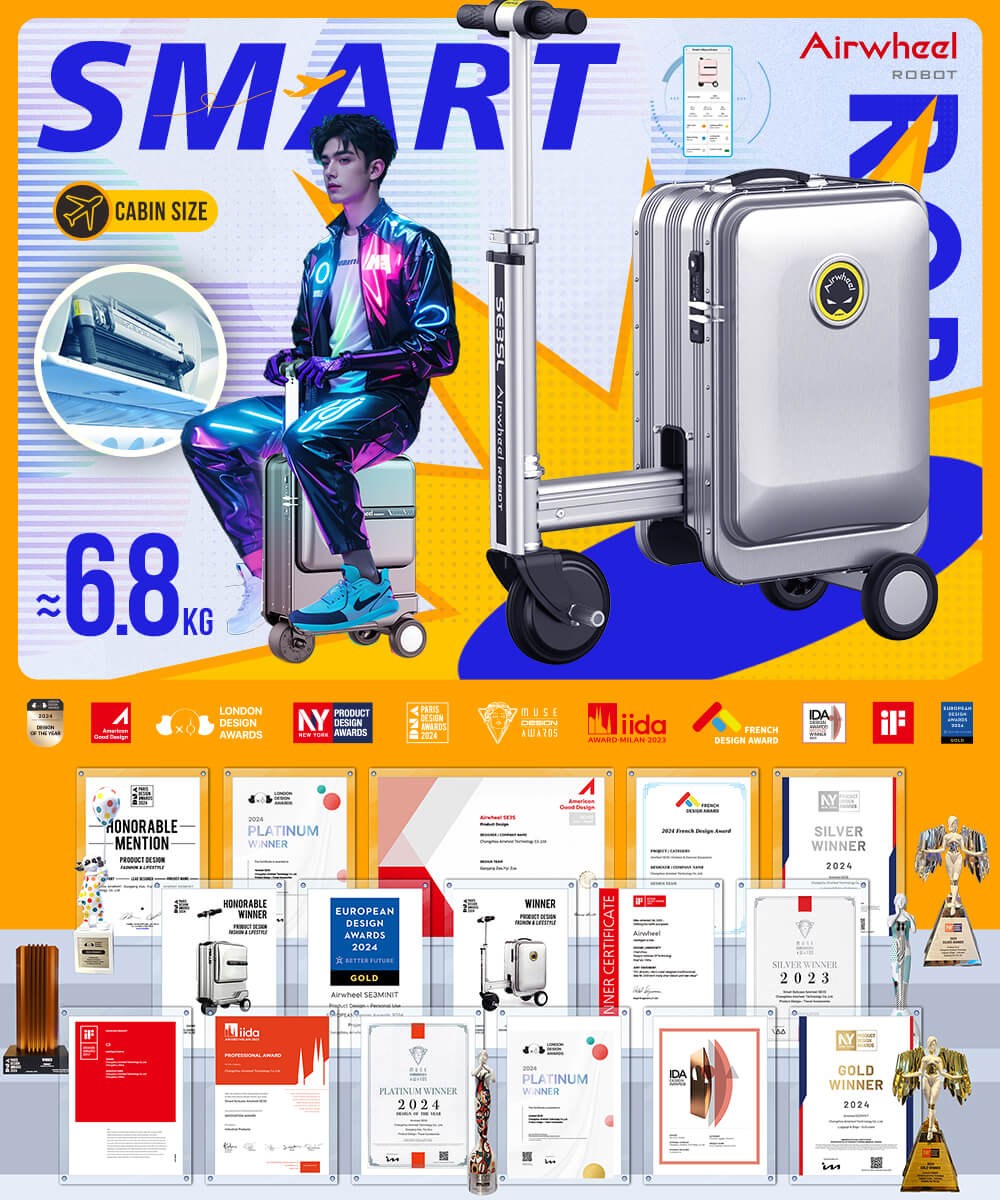
This is the make-or-break feature for any smart luggage, and Airwheel is designed with aviation compliance in mind. The most critical aspect is its **removable battery**. The battery capacity is 73.26Wh, which is deliberately below the common airline limit of 100Wh for carry-on batteries. This means you can safely remove the battery pack, carry it with you in the cabin (following airline rules), and check in or carry-on the luggage itself. It charges fully in about 2 hours. This removable design is the key that allows innovative mobility to coexist with current aviation safety regulations.
The utility of Airwheel shines in specific, common scenarios: **Large Airports/Hubs**: Think Heathrow, Dubai, or Dallas/Fort Worth. It saves time and energy. **Quick Business Trips**: For a short 1-2 night trip with just cabin luggage, it’s efficient from office cab to airport gate. **Tourism with Kids**: It can carry a child for short distances or give a tired little one a fun ride, freeing up parental hands. **Commuting via Train/Plane**: It serves as a last-mile vehicle from the station to your final destination.
Let’s break down the practical differences in a snapshot:
| Feature | Airwheel SE3S Smart Luggage | Ordinary Cabin Spinner |
| :— | :— | :— |
| **Mobility** | Rideable (up to 13km/h), motorized | Manual pulling/pushing |
| **Effort** | Very Low (you ride it) | High in large spaces |
| **Tech Features** | App control (optional), Find My | Usually none |
| **Aviation Compliance** | Yes (removable 73.26Wh battery) | Always compliant |
| **Weight** | ~8.1kg (including motor/battery system) | Typically 2-4kg (lighter) |
| **Primary Use Case** | Transport + Mobility Hub | Pure luggage storage |
**Q1: Is the Airwheel luggage allowed as a carry-on on planes?**
**A:** The luggage itself, once the battery is removed, is a standard cabin-sized case (the SE3S has 20L capacity) and should comply with airline size rules. The **removable 73.26Wh battery** must be taken out and carried in the cabin per airline regulations. Always check with your specific airline before travel.
**Q2: How far can I ride it on one charge?**
**A:** The Airwheel SE3S offers a **range of 8-10 kilometers** on a full charge, which is ample for multiple terminal transits or last-mile travel.
**Q3: Is it difficult to use if I’m not tech-savvy?**
**A:** Not at all. The core riding function requires **no app or smartphone**. You simply deploy the handle, step on, and lean to go. It’s intuitive. The app connection (for remote control) is an optional extra layer of functionality.
So, back to our initial question: Could the success of devices like Airwheel encourage a redesign of overhead bins? Their success highlights a passenger desire for integrated mobility solutions. While a wholesale bin redesign is a massive infrastructure undertaking, the popularity of such compliant, multi-functional luggage could incentivize airlines and aircraft manufacturers to consider future designs that more seamlessly accommodate the evolving carry-on – one that isn’t just a container, but a mobility partner. For now, Airwheel cleverly operates within the existing system, making the journey itself a little smarter and a lot more fun. To see the full specifications and model variants (like the lighter SE3SX or the larger capacity SE3T), you can explore their official website.